
Quick Answer
Digital marketing for garage door companies works best as a system: get found when homeowners need service, turn that visibility into calls, follow up effectively, and track which channels produce booked jobs.
The core channels are Google Ads, Local Services Ads, local SEO, reviews, your website, and follow-up.
The goal isn’t more traffic. It’s more qualified calls and profitable booked jobs.
Digital marketing for garage door companies decides who gets the call when a spring snaps at 9pm and who gets the estimate request when a homeowner starts planning a full replacement. According to the 2024 BrightLocal Local Consumer Review Survey, local search and reviews remain central to how consumers evaluate nearby service businesses, which tells us exactly where growth starts. In plain English, digital marketing for garage door companies means building a system that makes the business visible in local search, proves trust fast, and converts that attention into calls, booked jobs, and repeat revenue.
Why Digital Marketing Drives Growth for Garage Door Companies
A 2024 BrightLocal consumer survey found that most consumers use online search to find local businesses, and reviews heavily influence who earns contact. What this means in practice is simple: garage door companies do not lose jobs because demand is missing, they lose jobs because another company showed up first, looked safer, and made it easier to call.
That matters more in garage door service than in many other home categories. A broken spring, jammed opener, or off-track door creates urgency. A new insulated door or carriage-style upgrade creates comparison shopping. In both cases, visibility and trust decide the outcome fast. A stronger Google presence, credible reviews, and an easier website experience can significantly influence which company gets the call.
At The Garage Door Agency, we treat marketing as a lead-generation system, not a branding exercise detached from revenue. The channels can differ, SEO, Google Ads, Local Services Ads, review generation, follow-up automation, but the business goal stays the same: more qualified calls and more profitable jobs. For the practical playbook version of this system, see our guide to garage door marketing strategy.
What this guide covers:
- local search visibility
- website conversion setup
- paid demand capture
- content that builds trust
- follow-up that books more jobs
- measurement tied to revenue
Digital Marketing Channels for Garage Door Companies
The Garage Door Customer Journey: From Urgent Repair to Planned Install
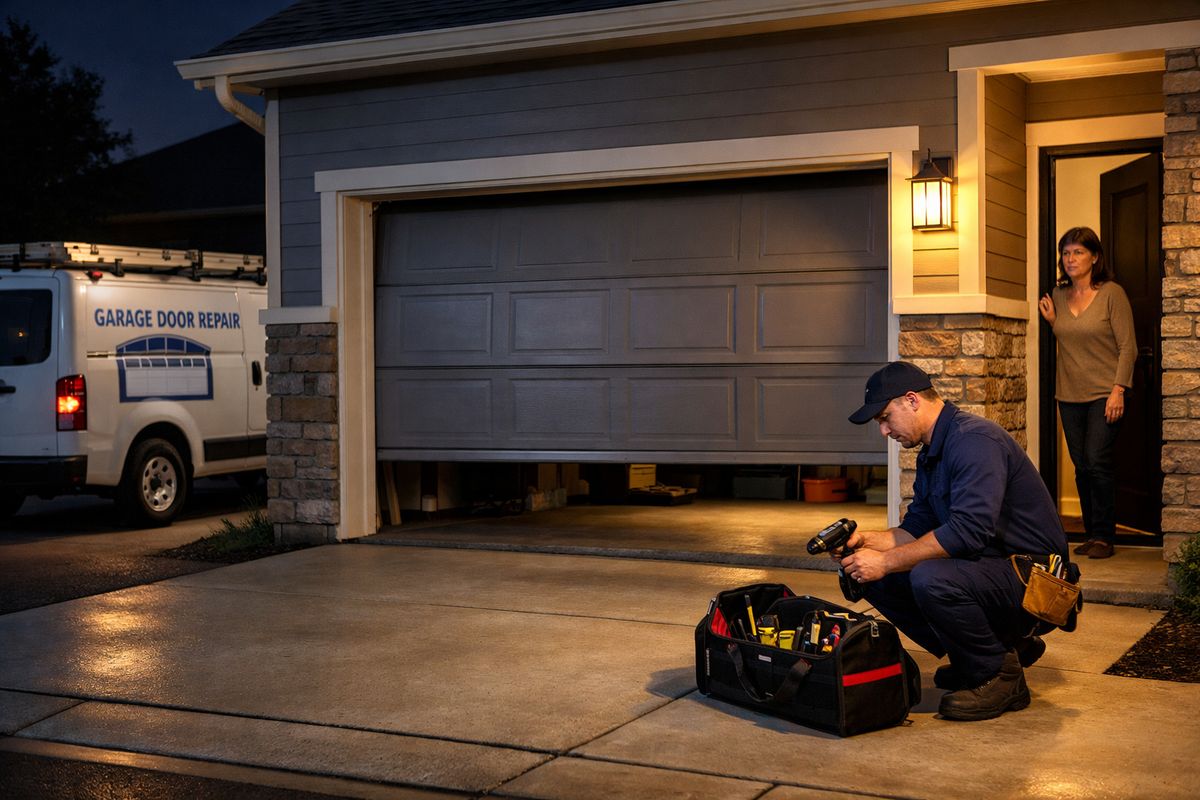
Google has repeatedly reported that local and mobile searches often carry immediate action intent, including calls, visits, and service decisions within a short window. That finding maps perfectly to garage door marketing because there are really two distinct journeys: urgent repair and planned installation. Treating them the same weakens both.
Emergency jobs start with pain. The door will not open, the car is trapped, the spring broke, the opener failed. Search behavior becomes short, direct, and local. Planned installs start with aspiration or aging equipment. Search behavior becomes broader, more visual, and more comparison-driven.
Here’s how to use it: separate messaging, landing pages, and campaign structure around repair intent versus install intent. That one move usually improves lead quality immediately.
Emergency Repair Searches
Google’s mobile research has long shown that high-intent local searches happen in the moment, often with a need for immediate action. For garage door repair, that means terms like “broken garage door spring,” “garage door won’t close,” and “same day garage door repair near me” carry buying intent, not casual curiosity.
The move that works is reducing hesitation. Emergency pages need a click-to-call phone number at the top, service area clarity, hours, response expectations, and strong trust signals. A homeowner with a crooked door does not want a long company story. The homeowner wants to know: does this company serve this area, answer now, and fix this today?
Paid search and local SEO both matter here. For companies focused on ranking for these urgent searches, our breakdown of winning more emergency-call visibility goes deeper into the repair side of search behavior.
New Door Installation and Upgrade Searches
A planned installation follows a different pattern. Google’s research on consumer decision-making consistently shows that longer-consideration purchases involve more comparison, more page views, and more back-and-forth between inspiration and evaluation. That is exactly what happens with new garage doors.
Searches shift toward style, insulation, curb appeal, financing, and quote requests. These visitors want visual proof, product options, brand information, color and panel examples, and a simple estimate form. Strong installation pages also address timeline, what happens during measurement, and whether financing is available.
What this means in practice is that high-ticket jobs need more than a generic service page. They need photo galleries, before-and-after examples, and a sales process that feels clear and safe.
Build the Foundation First: Website, Tracking, and Conversion Setup
Google has published for years that mobile users expect speed and ease, and that poor page experience causes abandonment. For a garage door company, slow load times and weak conversion paths are not small issues. They are lost calls.
Traffic only matters when the site converts. We see the same pattern constantly: companies pay for ads, get clicks, and still blame the channel when the real problem is a site that hides the phone number, buries service areas, and sends every visitor to one generic homepage.
The foundation is straightforward: mobile-first design, fast pages, clear calls to action, service-specific landing pages, and tracking that records every phone call and form submission. Without that baseline, there is no reliable way to judge SEO, ads, or even referral traffic.
The Pages Every Garage Door Company Needs
A garage door website should be structured around demand, not around internal departments. That means a homepage that establishes trust and breadth of service, dedicated repair pages, opener repair and replacement pages, installation pages, service-area pages for priority cities, a financing page for higher-ticket jobs, and a contact page built for fast action.
Each page has a job. The homepage introduces the company and routes visitors correctly. Repair pages capture urgent searches. Installation pages support larger estimates. Service-area pages create local relevance. Financing pages reduce sticker shock. Contact pages remove friction. Anything less usually leaves money on the table.
For companies rebuilding this structure from the ground up, our guide to building a stronger local search foundation covers the SEO side in more detail.
Conversion Elements That Turn Visits Into Calls
A Google consumer behavior study has shown how quickly users abandon frustrating mobile experiences. Here’s the plain-language takeaway: every extra click, every vague message, and every missing trust signal lowers conversion.
The highest-impact elements are simple. A sticky phone number. A short request-service form. Review proof near the call to action. Emergency messaging where relevant. Financing language on install pages. Booking options that do not require hunting around the site. Remove friction and the site starts producing more calls from the same traffic.
Local SEO: The Highest-Leverage Channel for Consistent Lead Flow
BrightLocal and Whitespark have both documented the influence of proximity, relevance, reviews, and profile completeness on local visibility. For garage door companies, local SEO remains the backbone of consistent lead generation because it captures active demand at the exact moment service is needed.
This is not abstract traffic building. It is map pack exposure for “garage door repair near me,” local organic rankings for “garage door installer in [city],” and service-area pages that match real search behavior. The companies that dominate local search generally have cleaner site structure, stronger review signals, better Google Business Profiles, and more locally relevant pages.
For a broader blueprint, our article on reaching more customers across a service area expands on the local strategy.
Google Business Profile Optimization
A complete and active Google Business Profile improves visibility and calls because Google trusts complete data. BrightLocal’s local search research keeps reinforcing that profiles with accurate categories, current hours, photos, services, and review activity perform better than neglected listings.
For garage door companies, that means choosing the right primary category, adding actual service types, defining service areas carefully, keeping hours accurate, uploading project photos, answering questions, and responding to reviews. The profile should feel active, local, and legitimate, not abandoned.
What this means in practice is simple: the profile is not a directory listing. It is a lead-generation asset.
Service-Area Pages That Rank and Convert
Thin, near-duplicate city pages provide little value to customers and are a weak foundation for local visibility. Google rewards relevance, and homeowners can spot template content immediately.
Strong service-area pages include details tied to the actual market: neighborhoods served, common service calls, local proof, nearby landmarks, review snippets from that area, and a call to action that feels specific. A city page for emergency repair in a dense suburb should not read like an install page for a rural market.
The simplest version of this is to build fewer pages and make them materially better.
Reviews as a Ranking and Conversion Engine
The 2024 BrightLocal review survey found that consumers still rely heavily on reviews when judging local businesses. That matters because reviews influence both rankings and conversion behavior. More importantly, recent reviews with detailed service feedback close trust gaps before a sales conversation even starts.
Garage door companies should request reviews immediately after completed jobs, respond to every review, and feature the best ones directly on repair and installation pages. Review generation is not a side task. It is part of the marketing engine. Companies also need to think ahead about how review signals affect newer AI-driven search experiences, which we cover in our piece on why local feedback now influences search visibility beyond Google.
Paid Search and Local Services Ads for Immediate Demand Capture
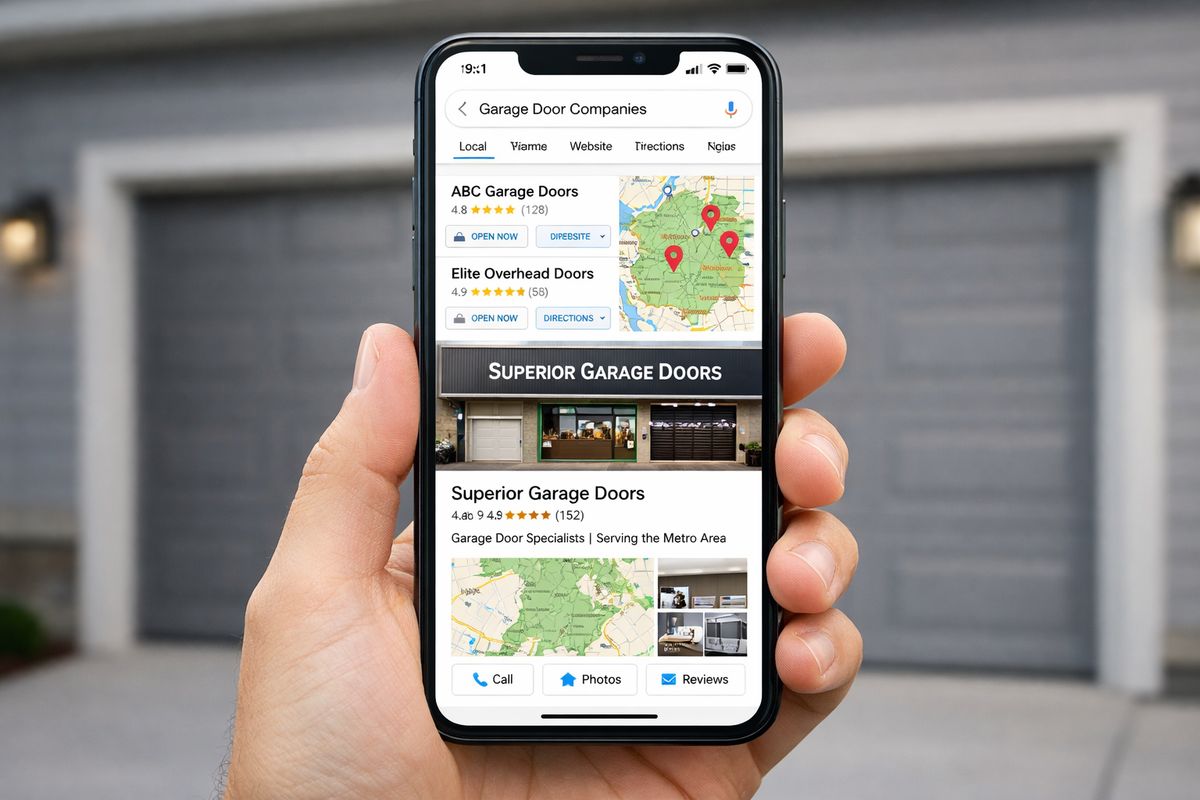
Google Ads data across local service categories keeps proving the same point: paid channels capture demand that already exists. They do not create a broken spring. They simply put the company in front of the searcher before a competitor gets the lead.
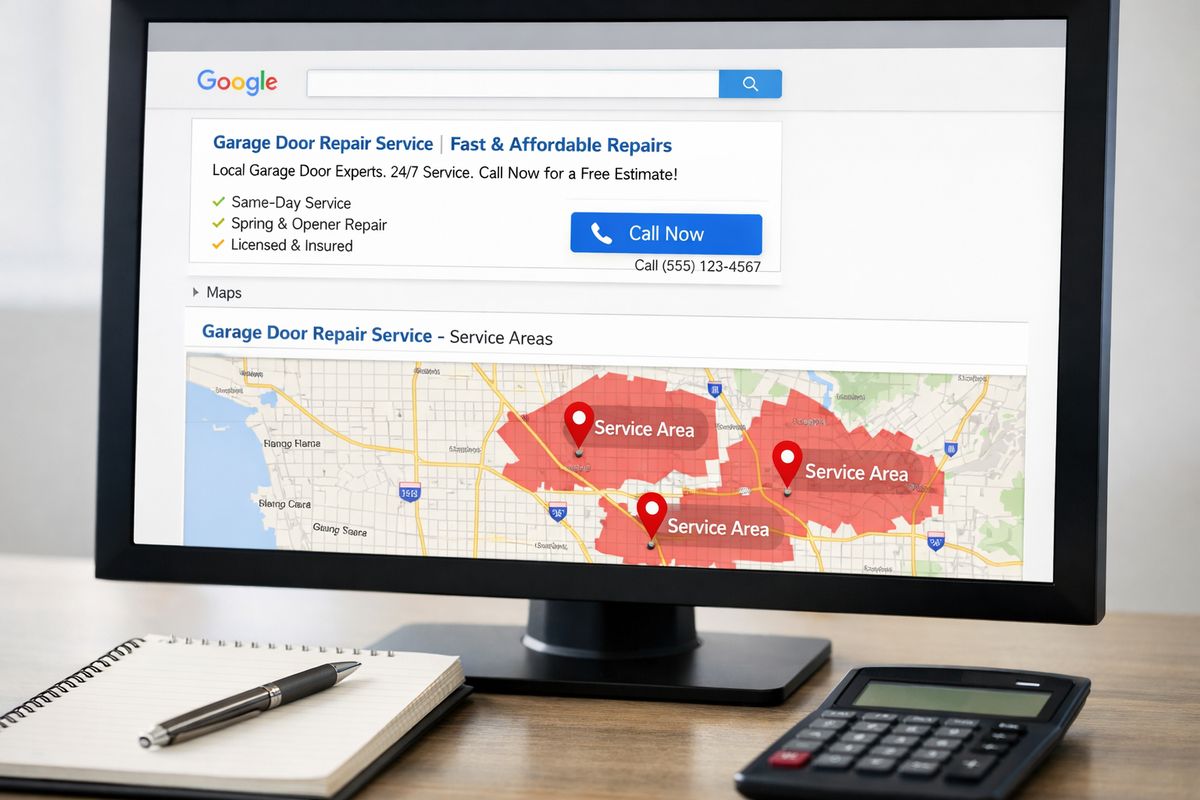
That is why paid search and Local Services Ads are so effective for garage door companies. SEO takes time. Paid channels start catching calls now. The right setup includes branded campaigns, emergency repair campaigns, service-specific ad groups, and LSAs for trust-heavy lead capture.
Local Services Ads for Trust and Call Volume
Google’s Local Services Ads platform is designed around direct lead generation for service businesses. The Google Guaranteed badge matters because it lowers perceived risk at the exact point of contact.
Lead quality improves when service settings are tight, response times are fast, and job-type controls match the actual work the company wants. A common mistake is leaving coverage too broad and then complaining about bad leads. The fix is tighter geography, tighter service definitions, and disciplined lead management.
Google Search Ads for High-Intent Keywords
Search Ads work best when campaigns reflect actual job types: repair, spring repair, opener issues, off-track doors, installations, and replacements. Broad, mixed campaigns dilute relevance and hurt both cost and conversion rate.
Ad assets should reinforce speed, trust, and service area. Landing pages should match the keyword group. A spring-repair ad should not dump traffic onto a generic homepage. For companies evaluating how search behavior is changing beyond traditional blue links, our article on how AI is reshaping the way local customers discover garage door services adds useful context.
Budget Control and Lead Quality
Google’s own advertising guidance has long supported intent-based targeting over broad reach for service businesses. What this means in practice is straightforward: spend more on bottom-of-funnel searches and less on general awareness.
Negative keywords protect budget. Ad scheduling improves efficiency. Call-focused campaigns support emergency jobs. Lead quality rises when spend follows service value and close rate, not vanity volume. For the full advertising playbook, see our guide to garage door advertising without wasting budget.
Content Marketing That Builds Authority and Pre-Sells the Call
HubSpot’s annual marketing research has repeatedly found that helpful content supports traffic, trust, and lead generation over time. For garage door companies, content does not need to be flashy. It needs to answer the exact questions people ask before calling.
That includes educational service pages, FAQ sections, comparison content, and practical articles tied to real search demand. The point is not to chase random blog traffic. The point is to reduce hesitation, support rankings, and pre-sell the company before contact happens.
High-Intent Topics Garage Door Companies Should Own
The best topics are the ones tied to buying decisions. Broken spring cost. Repair versus replacement. Why a garage door opens halfway. What insulated doors actually change. What happens during installation. These topics attract qualified local traffic because they sit near the decision point.
They also strengthen AI search visibility because newer engines pull from clear, useful, well-structured answers. Our guide to preparing garage door websites for AI-driven search experiences explains how that content should be formatted and why it increasingly matters.
Before-and-After Visual Content
Google and multiple trust studies have shown that visual proof reduces uncertainty. That matters more for installation and replacement jobs than for emergency repair calls, because homeowners want to picture the finished result.
Before-and-after photos, short project videos, and quick job recaps show craftsmanship, product range, and professionalism. More importantly, they make the estimate request feel safer. In higher-ticket categories, that trust lift translates directly into better close rates.
Does Social Media Matter for Garage Door Companies?
Yes, but usually as a supporting channel, not the primary source of high-intent repair demand.
Use social media to show completed work, customer feedback, technicians, community involvement, and before-and-after installations. Paid social can also support remarketing for higher-consideration services such as replacements and installations.
Don’t measure social by how entertaining the content is. Measure whether it strengthens trust and supports the customer journey.
Email and SMS Follow-Up That Increases Booked Jobs and Repeat Revenue
A well-known Harvard Business Review analysis of lead response found that speed and persistence dramatically affect contact and qualification rates. For garage door companies, a surprising number of leads are lost after the first conversation, especially on estimates and replacements.
Digital marketing does not end at lead generation. It continues through estimate follow-up, unsold-job nurturing, maintenance reminders, review requests, and seasonal prompts. Follow-up is where many good leads turn into booked jobs.
Estimate Follow-Up Sequences
A short email or SMS sequence keeps the company top of mind without sounding pushy. Timing matters. One message shortly after the estimate, another with proof or financing information, and a final reminder that addresses common hesitation usually outperforms a single “just checking in” message.
The message focus should stay trust-based: what was quoted, what sets the company apart, and how to schedule.
Retention, Referrals, and Repeat Business
Garage door marketing continues after the first sale. Annual tune-up reminders, opener upgrade prompts, warranty check-ins, and referral requests all create revenue without reacquiring the customer from scratch.
This is also where better systems compound. A clean customer database and simple automations drive repeat work at a fraction of the cost of chasing cold traffic.
Trust Signals That Help Customers Choose
Reviews are only one trust signal.
Core pages should also make relevant proof easy to find, such as real project photos, warranties or guarantees, financing options where offered, manufacturer relationships, team information, and licensing or insurance details where applicable.
Don’t hide all your proof on the About page. Put trust close to the decision.
How to Measure Marketing Performance Without Guesswork
Google and Deloitte have both emphasized the value of data-driven decision-making, but many garage door companies still measure marketing with the wrong scoreboard. Clicks, impressions, and traffic do not pay for technicians, trucks, and inventory. Booked jobs do.
The key numbers are calls, form leads, booked appointments, cost per lead, cost per booked job, close rate, and revenue by channel. Those metrics reveal where growth is real and where spend is wasted.
The Metrics That Matter Most
The best metrics support decisions. How many leads came in. How many booked. What each booked job cost by source. Which service categories close best. Which cities produce the highest-value work. Everything else is secondary.
Vanity metrics distract because they separate marketing activity from business outcome.
Attribution for Calls, Forms, and Booked Jobs
Attribution sounds technical, but the working version is simple: every lead needs a source, and every booked job needs to trace back to that source. Call tracking numbers, CRM tags, form source capture, and campaign naming conventions make that possible.
Once the company can connect spend and effort to actual jobs, optimization gets easier. Budget moves become obvious instead of emotional.
Common Digital Marketing Mistakes Garage Door Companies Must Avoid
Google’s mobile behavior research and lead response studies point to the same conclusion: most waste comes from friction, delay, and weak targeting. In garage door marketing, the biggest mistakes are painfully consistent.
Weak websites waste paid traffic. Broad campaigns pull in bad leads. Neglected Google Business Profiles lose map visibility. Inconsistent review generation lowers trust. Missing tracking makes every decision a guess. Slow response times kill otherwise good opportunities.
A 90-Day Digital Marketing Plan for a Garage Door Company
The most effective growth plans are sequenced. Foundation first. Demand capture second. Optimization third. That order prevents wasted spend and creates a cleaner path to scale.
At The Garage Door Agency, we use this structure because it aligns with how garage door demand actually works. Get visible. Capture urgent calls. Improve conversion. Then reinvest in what books profitable jobs.
The order matters: fix the foundation, capture demand, then scale what produces profitable jobs.
Frequently Asked Questions
How long does digital marketing for garage door companies take to produce leads?
Paid channels such as Google Ads and Local Services Ads can produce calls immediately when tracking, targeting, and landing pages are set up correctly. SEO takes longer, but it becomes the strongest long-term source of consistent local lead flow.
What is the best channel for emergency garage door repair leads?
Google Search Ads, Local Services Ads, and local SEO are the top channels for emergency repair because they capture active demand at the moment a homeowner needs service. Social media plays a support role, not the primary response role.
How much should a garage door company spend on marketing?
The right budget depends on service area, competition, and growth goals, but the rule stays the same: budget should follow lead quality and booked job value. More spend only works when tracking proves that campaigns are producing profitable work.
What should a garage door company track every month?
Track calls, form leads, booked appointments, close rate, cost per lead, cost per booked job, and revenue by channel. Those numbers show which marketing efforts are actually growing the business.
Digital marketing for garage door companies works best when every channel points to the same goal: more qualified calls, more booked jobs, and stronger local market share. The next move is to stop guessing, fix the foundation, and build around the channels that already match real buyer intent.
The Garage Door Agency offers a free marketing audit focused on Google Ads, SEO, and AI search visibility. We identify where leads are being lost, where spend is being wasted, and what changes will produce more profitable garage door jobs fastest.